And while I was doing this, I saw your blog Roman (http://kas1e.blogspot.com/) left with no updates. I bet we could read some fine posts from you again. Should we hope for it?
And while I was doing this, I saw your blog Roman (http://kas1e.blogspot.com/) left with no updates. I bet we could read some fine posts from you again. Should we hope for it?
Yes please, Roman! Even if your blog just serves to introduce your great videos.
@walkero,trixie I just find out blogs to be something you spend a lot of time on, but they did not get much attention. I mean, you wrote nice articles, spend a lot of work on them, and they disappeared into the dust after few weeks. And no one will read them outside, as they didn't have many frameworks behind like saying youtube, where anyone typing "amigaos4" can found your work.
But i surely love to read amigaos4 blog articles :)
Speaking about my videos (And sorry for OT, but as Trixie ourself bring it here, so hope he in interst about too), i finished today my problably first "big" video i spend 2 weeks on : "Sam460: from the Begining to the End". It's pretty long 45 minutes video, about SAM460. With music, subtitles, lot of editing-video work, etc, etc. Not "that" proffesional of course, but probably one of not bad ones from me.
PART 1: Unpacking the package and close look at motherboard - 0:15 till 4:35 PART 2: The first run. Tests on the Table. | 4:30 till 9:00 PART 3: Installing into the case. Vertical GFX setup. | 9:10 till 20:45 PART 4: Installing of AmigaOS4 FE. an USB Stick way. | 20:55 till 26:20 PART 5: The basic configuration : Network, Audio and Extrass | 26:30 till 30:35 PART 6: UP 2 DATE. Installing Update1 and Update2 | 30:45 till 36:20 PART 7: Full settings. Real-life performance | 36:30 till 45:15
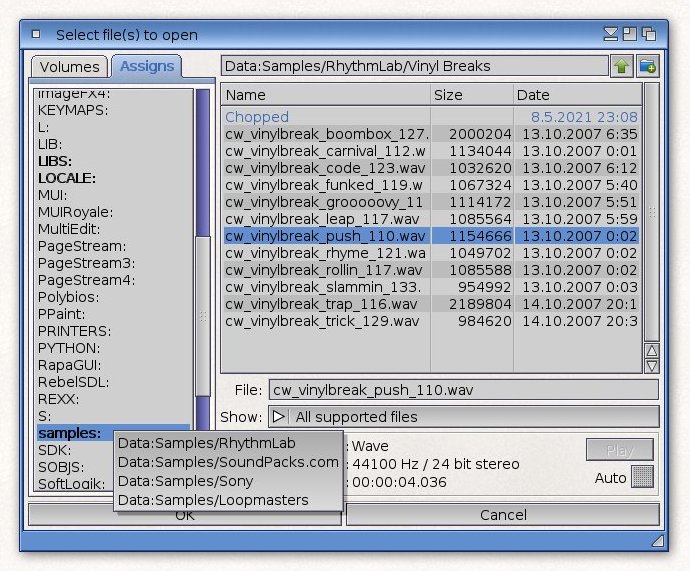
A small update to the latest article on the Rear Window blog. The file requester module of the Rave audio editor now supports DOS multi-assigns. As the screenshot below shows, multi-assigns are shown in bold and when you double-click on them, you can select one of the associated paths from a pop-up menu.
@trixie This is really awesome. The popup on the multiassign is a hidden chooser? So, you check the node at the listbrowser for multiassigns and you dynamically create a hidden chooser?
Do you use UserData to keep that information on the node, or something else?
Do you have any idea of an approximate release date?
As I explained in the blog post, things unfortunately got delayed due to the lockdown parenting hell, but I'll definitely give you something to play with this summer.
The popup on the multiassign is a hidden chooser? So, you check the node at the listbrowser for multiassigns and you dynamically create a hidden chooser? Do you use UserData to keep that information on the node, or something else?
I scan the DOS volumelist for the current list of volumes and assigns, and if a specific assign is marked as a multi-assign, I scan it for the associated paths. These end up on a Chooser list, which I store within the respective ListBrowser node. But I don't use LBNA_UserData for this. Instead, each ListBrowser node in the requester's list of assigns is allocated as a custom node via AllocListBrowserNode() and LBNA_NodeSize (which has the size of my custom node structure). The Chooser list is then stored as a pointer in the custom node structure.
The advantage of this is that upon selection, I can simply GetAttr() the LISTBROWSER_SelectedNode attribute and read the Chooser list pointer from the node structure. In other words, I spare a subsequent GetListBrowserNodeAttrs() call to retrieve LBNA_UserData.
The multi-assign path selector is indeed a hidden chooser. I create one such chooser for the file requester. When a multi-assign gets double-clicked, I retrieve the Chooser list pointer from the ListBrowser node, set CHOOSER_Labels to point to the respective list, and then open the hidden chooser via ActivateGadget().
Of course I have a notification on the DOS volumelist, so the list of volumes and assigns gets rebuilt with every change reported by DOS. I also rebuild the list whenever the file requester reopens.
@trixie Pretty smart way to do it. Thank you for the explanation. Did you see any slow downs on requester open? When you do the first scan? When you start the application or when the user first open the requester? Have you tried it on Sam440 you have to see how fast it is?
Instead of a chooser, did you try with Hierachical nodes/entries (those with [+]) or does it mess everything up?
I was considering hierarchical nodes, but in the end I settled for the chooser. The reason is that the multi-assign path strings can get quite long and won't fit in the listbrowser area. So you'll have to use a horizontal scroller to see the paths in full. This is more awkward than simply selecting from the chooser pop-up. Another reason is that the standard system ASL requester uses a similar solution: when you double-click on a multi-assign, a pop-up selector opens.
Did you see any slow downs on requester open? When you do the first scan? When you start the application or when the user first open the requester?
At application start-up I only build the requester object (including GUI). I scan the DOS volumelist whenever the user opens the requester (and, as I mentioned above, when there is a change notification from DOS).
Quote:
Have you tried it on Sam440 you have to see how fast it is?
My Sam440ep-Flex is currently in storage, waiting for me to find time to install Update 2 on it. But I've tested the program under emulation (OS4.1 for Classic in WinUAE), and the requester opens almost immediately. So I'd say the volumes/assigns scan is fast. And I can tell you that my emulated system is much slower than the Sam440.
But I've tested the program under emulation (OS4.1 for Classic in WinUAE), and the requester opens almost immediately. So I'd say the volumes/assigns scan is fast. And I can tell you that my emulated system is much slower than the Sam440.


 News feed
 OS4 Feedback forum
 OS4Depot Feedback forum
 AmiCygnix forum
 ABC shell forum
 AmiKit forum
 Cinnamon Writer forum
 CodeBench forum
 Digital Universe forum
 Dopus 5 forum
 E-UAE forum
 Gnash forum
 Ibrowse forum
 JAmiga forum
 Odyssey forum
 OWB forum
 Qt forum
 SmartFileSystem forum
 Timberwolf forum
 TouchDevice forum
 TuneNet forum
 Unsatisfactory Software forum
 Donate