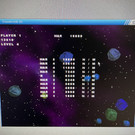
---> CPU L1 L2 RAM VIDEO BUS
Ptr_Comp: 1025591824
should be: (implementation-dependent)
Discr: 0
should be: 0
Enum_Comp: 2
should be: 2
Int_Comp: 17
should be: 17
Str_Comp: DHRYSTONE PROGRAM, SOME STRING
should be: DHRYSTONE PROGRAM, SOME STRING
Next_Ptr_Glob->
Ptr_Comp: 1025591824
should be: (implementation-dependent), same as above
Discr: 0
should be: 0
Enum_Comp: 1
should be: 1
Int_Comp: 18
should be: 18
Str_Comp: DHRYSTONE PROGRAM, SOME STRING
should be: DHRYSTONE PROGRAM, SOME STRING
Int_1_Loc: 5
should be: 5
Int_2_Loc: 13
should be: 13
Int_3_Loc: 7
should be: 7
Enum_Loc: 1
should be: 1
Str_1_Loc: DHRYSTONE PROGRAM, 1'ST STRING
should be: DHRYSTONE PROGRAM, 1'ST STRING
Str_2_Loc: DHRYSTONE PROGRAM, 2'ND STRING
should be: DHRYSTONE PROGRAM, 2'ND STRING
Duration in seconds: 14.7
Microseconds for one run through Dhrystone: 0.3
Dhrystones per Second: 3390909.2
Dhrystone MIPS (DMIPS) 1929
Perhaps you could host it on your GitHub, complete with a short installation guide? That would be great.
Not at the moment. The thing is, as part of my hobby work, I have a to-do list for this project. Sharing the source code right now would just lead to questions like “Why isn’t this working?” or “Why is it working incorrectly for someone?” or “How can this be improved?” I don’t need the hassle that comes with that or to waste time on it. I’ll post updates on my progress here.
@ldg72 MGL- people are determined to get Minecraft running on macOS with shaders. I found some cool stuff, and surprisingly, it might actually work The limitation to OpenGL 4.3 is solely related to BE.
@ldg72 A little background on where I got my ideas. One of the QEMU developers, Akihiko Odaki, once bought a Mac M1 and decided to run Linux on it. He developed his own branch of patches for macOS to enable the Virgil 3D GPU to do this. He also drew on the work of knazarov. He’s currently using Asahi Linux (one of the most spectacular achievements regarding Linux and running it on Apple ARM), and the project is being further developed by others who are building on his idea. Here is his page regarding M1 QEMU and Linux -> https://gist.github.com/akihikodaki/87 ... 9e7ca87f18dc56807ec5a1bc5
My patches aren’t based on Homebrew (though some code might come from the original patches—I haven’t been following the history of Akihiko Odaki’s repository). I use vanilla QEMu + patches to make it work on PPC/AOS4 macOS. I don’t download anything from Homebrew except for the packages needed for compilation. If you don’t want to use Cocoa and prefer SDL, you can also use the macOS patches by kjliew (qemu 3dfx). They definitely work on Linux arm64 Fedora 38—I checked that a while back.
The biggest problem is that macOS is only partially compatible with OpenGL. The Mesa library uses only what the host provides in guest mode. Not everything will work, but that’s not the library’s fault—it’s the host’s (macOS). The limit is Apple OpenGL 4.1
I haven’t done this yet, and I don’t plan to for now because the driver is supposed to be universal across all platforms, which is a major challenge (maybe in the future, but it might turn out to be uneconomical or inefficient with QEMU PPC32). - The limitation might be workable with Venus/Metal -> https://github.com/startergo/homebrew-qemu-virgl-kosmickrisp I’ll test “Craft” on macOS and let you know here. It’s possible that all you need to do is run `setenv MESA_GLES_VERSION_OVERRIDE 3.1`
I’m currently working on something like this under QEMU’s virtopgpu and Mesa to fulfill the dream of a real web browser on AOS4/QEMU.
He doesn't understand one thing—why go against the grain, especially since it's already clear that the native browser on AOS4, even if it's developed, will be limited. Wouldn’t it be simpler to just use a client for a real web engine? Here’s a little test (dev).
P.S. The version has been slightly modified for VirtioGPU. “Comp” works on VirtioGPU, but it’s simpler and more efficient to move certain things from emulation to Mesa. Video lag is currently limited by the server, which is targeted at 25 frames per second. I hope @TearsOfMe won’t mind that I’m tweaking it a bit for QEMU .
I’m working on versions of QEMU and VirtioGPU to make them work on macOS. With QEMU, I’d need to apply a few patches for ‘Cocoa’, as well as some related to the PPC FPU from the mailing list and a bit of old code I’d had on my hard drive for ages. Something wasn’t working for me, so AI came to the rescue. I spent a week testing our fixes.... The results so far are very interesting. Does a Mac Mini M4 with Mesa3D perform better than an average x5000 with a Radeon RX? Also, check out the smoothness in the Odyssey browser.
@ldg72 @Maijestro It will work on macOS, but here it requires some additional adaptation—and maybe a different version of QEMU; I’m not sure. I’m currently testing the code on arm/x86 Linux. My approach is based on suggestions from @balaton and @joerg—code that’s well-written and executed within the guest may run faster in emulation than if it’s blindly pushed out to the host. This requires some work, and adding another machine (macOS) that doesn’t have OpenGL would only cause chaos.
@LiveForIt @joerg @samo79 @K-L If I may chime in on this discussion. For now, it looks like the program will be ported to AOS4 from the original code. If the original version uses “ibfreetype + fontconfig,” then even if someone were doing this without AI, they wouldn't bother with it. The priority is stable code, and then fine-tuning. Why create problems for yourself right from the start? There will definitely be time for that later.
@ldg72 You might find this interesting—my Virtio AmigaOS4..world It's a little boring; feel free to fast-forward. The video is an older, chaotic dev presentation (snapshot) of mine. Here’s my driver: virtop-gpu with COMP and warp3d, based on open-source code from @derfs and wazp3d virtio-net (the only network driver that works perfectly for me in QEMU), also thanks to the source code shared by @derfs virtio-sound, thanks to the open-source code from @afxgroup
Once I’m done (hopefully), everything will be available to the public for free *) For some parts related to the driver code, code generated by AI was used
@derfs Could you specify the licenses for your source files at https://github.com/derfsss/VirtIOGPU? Unfortunately, there’s no license listed here, and you can’t share anything related to your source files? Unless you don’t agree to that—I’ll understand. I’m just asking. Thanks
@Kirirur Use the ATI driver for QEMU by BALATON Zoltan; “PatchCompositeTags” should work in 32-bit mode. https://zero.eik.bme.hu/~balaton/qemu/ ... ti-vga-driver-latest.html Don’t expect miracles. The ATI driver by BALATON Zoltan alone will definitely work better for you than @derfsss’s VirtIOGPU. VirtIOGPU uses a running flush process (this virtio-gpu implementation requires it—it’s not a bug by @derfsss) that consumes a lot of CPU on the guest side. It would be possible to implement full compositing, but that’s completely pointless when the flush process itself on the AmigaOS4 side would consume 30–40% of the CPU. Take a look here—you’ll find a benchmark of empty functions at https://hdrlab.org.nz/benchmark/gfxbench2d/os/amigaos/Result/3056, in the “Composite Score” section. I don’t know how @Hans’s (A-EON) driver works. It might work with IGFX_COMPOSITETAGLIST_OFFSET set to 804 or 806, but if it operates on the same principle—with the flush process consuming CPU resources—then it’s definitely better to use BALATON Zoltan’s ATI driver for QEMU.
@kas1e New test - Mesa 1.1 QEMU Pegasos2 PCI passthrough Radeon HD Interesting result: GLMark2 Score: 954 Is this result better than the Sam460 with a Radeon RX? The Pegasos2 QEMu machine is the same one used in this test: https://www.amigans.net/modules/newbb/ ... id=161731#forumpost161731
Here’s the full test: Quote:
======================================================= glmark2 2023.01 ======================================================= OpenGL Information GL_VENDOR: AMD GL_RENDERER: VERDE (radeonsi, verde, ACO, RM 1.0, 54.57 (29.7.2023) Pegasos 2 release) GL_VERSION: 4.3 (Compatibility Profile) Mesa 26.1.5 (git-2e7650ee6e) System Info: mesa.library 1.1 (1.9.2026), RadeonHD 3.7 Surface Config: buf=32 r=8 g=8 b=8 a=8 depth=24 stencil=0 samples=0 Surface Size: 800x600 windowed ======================================================= [build] use-vbo=false: FPS: 54 FrameTime: 18.633 ms [build] use-vbo=true: FPS: 1276 FrameTime: 0.784 ms [texture] texture-filter=nearest: FPS: 1156 FrameTime: 0.865 ms [texture] texture-filter=linear: FPS: 1161 FrameTime: 0.862 ms [texture] texture-filter=mipmap: FPS: 1169 FrameTime: 0.856 ms [shading] shading=gouraud: FPS: 1296 FrameTime: 0.772 ms [shading] shading=blinn-phong-inf: FPS: 1312 FrameTime: 0.762 ms [shading] shading=phong: FPS: 1297 FrameTime: 0.771 ms [shading] shading=cel: FPS: 1315 FrameTime: 0.761 ms [bump] bump-render=high-poly: FPS: 1284 FrameTime: 0.779 ms [bump] bump-render=normals: FPS: 1251 FrameTime: 0.800 ms [bump] bump-render=height: FPS: 1245 FrameTime: 0.804 ms [effect2d] kernel=0,1,0;1,-4,1;0,1,0;: FPS: 1590 FrameTime: 0.629 ms [effect2d] kernel=1,1,1,1,1;1,1,1,1,1;1,1,1,1,1;: FPS: 1576 FrameTime: 0.635 ms [pulsar] light=false:quads=5:texture=false: FPS: 791 FrameTime: 1.265 ms [desktop] blur-radius=5:effect=blur:passes=1:separable=true:windows=4: FPS: 307 FrameTime: 3.266 ms [desktop] effect=shadow:windows=4: FPS: 261 FrameTime: 3.841 ms [buffer] columns=200:interleave=false:update-dispersion=0.9:update-fraction=0.5:update-method=map: FPS: 39 FrameTime: 25.780 ms [buffer] columns=200:interleave=false:update-dispersion=0.9:update-fraction=0.5:update-method=subdata: FPS: 26 FrameTime: 38.500 ms [buffer] columns=200:interleave=true:update-dispersion=0.9:update-fraction=0.5:update-method=map: FPS: 43 FrameTime: 23.454 ms [ideas] speed=duration: FPS: 119 FrameTime: 8.404 ms [jellyfish] : FPS: 848 FrameTime: 1.180 ms [terrain] : FPS: 157 FrameTime: 6.409 ms [shadow] : FPS: 608 FrameTime: 1.646 ms [refract] : FPS: 400 FrameTime: 2.504 ms [conditionals] fragment-steps=0:vertex-steps=0: FPS: 1379 FrameTime: 0.726 ms [conditionals] fragment-steps=5:vertex-steps=0: FPS: 1375 FrameTime: 0.727 ms [conditionals] fragment-steps=0:vertex-steps=5: FPS: 1387 FrameTime: 0.721 ms [function] fragment-complexity=low:fragment-steps=5: FPS: 1385 FrameTime: 0.723 ms [function] fragment-complexity=medium:fragment-steps=5: FPS: 1363 FrameTime: 0.734 ms [loop] fragment-loop=false:fragment-steps=5:vertex-steps=5: FPS: 1342 FrameTime: 0.746 ms [loop] fragment-steps=5:fragment-uniform=false:vertex-steps=5: FPS: 1339 FrameTime: 0.747 ms [loop] fragment-steps=5:fragment-uniform=true:vertex-steps=5: FPS: 1366 FrameTime: 0.732 ms ======================================================= glmark2 Score: 954 =======================================================
What have you been doing with GART optimization? Does this have anything to do with that result?
It works at least , but as expected (and as your previous tests with ogles2/gl4es/warp3dnova shows) on QEMU - slow. Once virtuogpu drivers will be ready we can hope for some improvements, but it also possible that emulation itself will slow this up anyway.
An issue related to QEMU and PCI passthrough. It’s been around for a long time. It chokes or stalls—to put it simply. As for the virtuogpu drivers, if it uses the blob and Vulkan/Venus for rendering instead of the “flush” process that uses the CPU on the guest machine, everything should work correctly and quickly But I don’t want to clutter up this thread with virtio topics.... thanks
I booted up my old machine QEMU 11 + Pegasos2, AmigaOne GPU passthrough GPU: Asus Radeon HD 7750 HOST CPU: Intel Core i5-3470 3rd generation Intel Core processors (2012)
Pegasos2: Quote:
======================================================= glmark2 2023.01 ======================================================= OpenGL Information GL_VENDOR: AMD GL_RENDERER: VERDE (radeonsi, verde, ACO, DRM 0.0, 54.57 (29.7.2023) Pegasos 2 release) GL_VERSION: 4.3 (Compatibility Profile) Mesa 26.1.5 (git-2e7650ee6e) Surface Config: buf=32 r=8 g=8 b=8 a=8 depth=24 stencil=0 samples=0 Surface Size: 800x600 windowed ======================================================= [build] use-vbo=false: FPS: 52 FrameTime: 19.282 ms [build] use-vbo=true: FPS: 692 FrameTime: 1.446 ms [texture] texture-filter=nearest: FPS: 658 FrameTime: 1.521 ms [texture] texture-filter=linear: FPS: 660 FrameTime: 1.516 ms [texture] texture-filter=mipmap: FPS: 656 FrameTime: 1.525 ms [shading] shading=gouraud: FPS: 691 FrameTime: 1.449 ms [shading] shading=blinn-phong-inf: FPS: 694 FrameTime: 1.442 ms [shading] shading=phong: FPS: 688 FrameTime: 1.454 ms [shading] shading=cel: FPS: 688 FrameTime: 1.456 ms [bump] bump-render=high-poly: FPS: 684 FrameTime: 1.463 ms [bump] bump-render=normals: FPS: 675 FrameTime: 1.482 ms [bump] bump-render=height: FPS: 674 FrameTime: 1.484 ms [effect2d] kernel=0,1,0;1,-4,1;0,1,0;: FPS: 751 FrameTime: 1.332 ms [effect2d] kernel=1,1,1,1,1;1,1,1,1,1;1,1,1,1,1;: FPS: 755 FrameTime: 1.326 ms [pulsar] light=false:quads=5:texture=false: FPS: 511 FrameTime: 1.958 ms [desktop] blur-radius=5:effect=blur:passes=1:separable=true:windows=4: FPS: 255 FrameTime: 3.931 ms [desktop] effect=shadow:windows=4: FPS: 223 FrameTime: 4.500 ms [buffer] columns=200:interleave=false:update-dispersion=0.9:update-fraction=0.5:update-method=map: FPS: 38 FrameTime: 26.486 ms [buffer] columns=200:interleave=false:update-dispersion=0.9:update-fraction=0.5:update-method=subdata: FPS: 26 FrameTime: 39.035 ms [buffer] columns=200:interleave=true:update-dispersion=0.9:update-fraction=0.5:update-method=map: FPS: 42 FrameTime: 24.323 ms [ideas] speed=duration: FPS: 111 FrameTime: 9.068 ms [jellyfish] : FPS: 528 FrameTime: 1.895 ms [terrain] : FPS: 141 FrameTime: 7.108 ms [shadow] : FPS: 420 FrameTime: 2.384 ms [refract] : FPS: 313 FrameTime: 3.204 ms [conditionals] fragment-steps=0:vertex-steps=0: FPS: 664 FrameTime: 1.508 ms [conditionals] fragment-steps=5:vertex-steps=0: FPS: 661 FrameTime: 1.515 ms [conditionals] fragment-steps=0:vertex-steps=5: FPS: 664 FrameTime: 1.507 ms [function] fragment-complexity=low:fragment-steps=5: FPS: 663 FrameTime: 1.509 ms [function] fragment-complexity=medium:fragment-steps=5: FPS: 664 FrameTime: 1.506 ms [loop] fragment-loop=false:fragment-steps=5:vertex-steps=5: FPS: 657 FrameTime: 1.524 ms [loop] fragment-steps=5:fragment-uniform=false:vertex-steps=5: FPS: 660 FrameTime: 1.516 ms [loop] fragment-steps=5:fragment-uniform=true:vertex-steps=5: FPS: 661 FrameTime: 1.514 ms ======================================================= glmark2 Score: 511 =======================================================
AmigaOne: Quote:
======================================================= glmark2 2023.01 ======================================================= OpenGL Information GL_VENDOR: AMD GL_RENDERER: VERDE (radeonsi, verde, ACO, DRM 0.0, 54.57 (29.7.2023) AmigaOne release) GL_VERSION: 4.3 (Compatibility Profile) Mesa 26.1.5 (git-2e7650ee6e) Surface Config: buf=32 r=8 g=8 b=8 a=8 depth=24 stencil=0 samples=0 Surface Size: 800x600 windowed ======================================================= [build] use-vbo=false: FPS: 46 FrameTime: 22.023 ms [build] use-vbo=true: FPS: 685 FrameTime: 1.460 ms [texture] texture-filter=nearest: FPS: 651 FrameTime: 1.538 ms [texture] texture-filter=linear: FPS: 649 FrameTime: 1.543 ms [texture] texture-filter=mipmap: FPS: 655 FrameTime: 1.529 ms [shading] shading=gouraud: FPS: 685 FrameTime: 1.462 ms [shading] shading=blinn-phong-inf: FPS: 687 FrameTime: 1.458 ms [shading] shading=phong: FPS: 684 FrameTime: 1.463 ms [shading] shading=cel: FPS: 679 FrameTime: 1.473 ms [bump] bump-render=high-poly: FPS: 685 FrameTime: 1.461 ms [bump] bump-render=normals: FPS: 674 FrameTime: 1.484 ms [bump] bump-render=height: FPS: 672 FrameTime: 1.488 ms [effect2d] kernel=0,1,0;1,-4,1;0,1,0;: FPS: 753 FrameTime: 1.330 ms [effect2d] kernel=1,1,1,1,1;1,1,1,1,1;1,1,1,1,1;: FPS: 747 FrameTime: 1.340 ms [pulsar] light=false:quads=5:texture=false: FPS: 500 FrameTime: 2.001 ms [desktop] blur-radius=5:effect=blur:passes=1:separable=true:windows=4: FPS: 254 FrameTime: 3.937 ms [desktop] effect=shadow:windows=4: FPS: 221 FrameTime: 4.534 ms [buffer] columns=200:interleave=false:update-dispersion=0.9:update-fraction=0.5:update-method=map: FPS: 37 FrameTime: 27.589 ms [buffer] columns=200:interleave=false:update-dispersion=0.9:update-fraction=0.5:update-method=subdata: FPS: 25 FrameTime: 40.725 ms [buffer] columns=200:interleave=true:update-dispersion=0.9:update-fraction=0.5:update-method=map: FPS: 41 FrameTime: 24.689 ms [ideas] speed=duration: FPS: 108 FrameTime: 9.271 ms [jellyfish] : FPS: 526 FrameTime: 1.904 ms [terrain] : FPS: 138 FrameTime: 7.276 ms [shadow] : FPS: 416 FrameTime: 2.404 ms [refract] : FPS: 315 FrameTime: 3.180 ms [conditionals] fragment-steps=0:vertex-steps=0: FPS: 699 FrameTime: 1.431 ms [conditionals] fragment-steps=5:vertex-steps=0: FPS: 698 FrameTime: 1.434 ms [conditionals] fragment-steps=0:vertex-steps=5: FPS: 700 FrameTime: 1.429 ms [function] fragment-complexity=low:fragment-steps=5: FPS: 702 FrameTime: 1.426 ms [function] fragment-complexity=medium:fragment-steps=5: FPS: 707 FrameTime: 1.415 ms [loop] fragment-loop=false:fragment-steps=5:vertex-steps=5: FPS: 702 FrameTime: 1.426 ms [loop] fragment-steps=5:fragment-uniform=false:vertex-steps=5: FPS: 698 FrameTime: 1.434 ms [loop] fragment-steps=5:fragment-uniform=true:vertex-steps=5: FPS: 690 FrameTime: 1.450 ms ======================================================= glmark2 Score: 518 =======================================================
Edited by smarkusg on 2026/8/22 7:55:01 Edited by smarkusg on 2026/8/22 7:55:32
More updates to follow — please keep testing and reporting!
I can tell you one thing after checking “https://github.com/Maijestro/mplayer/releases/tag/v306-beta” The problem with uploading this file for testing was that the bare executable file “mplayer_vaapi_hw_v306_stripped” was incorrect. As I assume, @TSK, when reporting the issue as a regular user and running the command “mplayer_vaapi_hw_v306_stripped,” doesn’t need to know about video outputs. They just run the command with the target file “video.” Your output settings are just a mess. You have duplicate video outputs. It’s possible you were using AI prompts where it asked you various questions—you reported the issues to it, and it gave you nonsense answers.
4.RAM Disk:> mplayer_vaapi_hw_v306_stripped -vo help

MPlayer SVN-r38685-FFmpeg7.1.4-AmigaOS4 (C) 2000-2026 MPlayer Team

Available video output drivers:

    vaapi    VA-API hardware accelerated video output

    comp_yuv2    Composition, yuv420p, direct rendering, has a thread for video output

    sdl    SDL YUV/RGB/BGR renderer (SDL v1.1.7+ only!)

    sdl    SDL YUV/RGB/BGR renderer (SDL v1.1.7+ only!)

    p96_pip    Picasso96 overlay

    comp_yuv2    Composition, yuv420p, direct rendering, has a thread for video output

    comp_yuv    Composition, yuv420p, direct rendering

    comp    Composition, R8G8B8

    wpa    Graphics.library / WritePixelArray (no window scaling)

    vaapi    VA-API hardware accelerated video output

    amiga    AmigaOS P96 video output

    null    Null video output

    mpegpes    MPEG-PES file

    yuv4mpeg    yuv4mpeg output for mjpegtools

    png    PNG file

    jpeg    JPEG file

    tga    Targa output

    pnm    PPM/PGM/PGMYUV file

    md5sum    md5sum of each frame
Here is the order of video outputs determined based on priority and in the absence of a configuration file. I don't know what else might be wrong, but I don't even check that… Checking code packed with artificial intelligence is a waste of time
The most logical thing, which should have been done earlier, is to take the good work done by Maijestro on his VAAPI driver and simply trasfer it to our standard MPlayer version. It had already been done to include all the features of the old releases scattered throughout version 1.5, which really, we didn't feel the need for another fork.
@Maijestro tried a few things to create a VAAPI video player for AOS4 (ffplay). I suggested he use what we had already done. He succeeded, and it’s great that he’s developing his own version. We now have many different options to choose from for playing video on AOS4. This is his project, and what he wants to do with it—what he plans to develop further and what to add from older versions of MPlayer—is entirely his decision.
You can always integrate VAAPI into MPlayer 1.5 (he’s shared the patches). Is anyone else interested in this?
Based on what @Maijestro has done, I’m most interested in whether it’s possible to integrate VAAPI with DVD playback via MPlayer for the Peg2. MPlayer 1.5 was capable of that (software mode). No one will definitely use this, but that’s why it’s such a cool idea Nowadays, when the whole world relies on streaming, owning and playing CD/DVD media is a luxury.


 News feed
 OS4 Feedback forum
 OS4Depot Feedback forum
 AmiCygnix forum
 ABC shell forum
 AmiKit forum
 Cinnamon Writer forum
 CodeBench forum
 Digital Universe forum
 Dopus 5 forum
 E-UAE forum
 Gnash forum
 Ibrowse forum
 JAmiga forum
 Odyssey forum
 OWB forum
 Qt forum
 SmartFileSystem forum
 Timberwolf forum
 TouchDevice forum
 TuneNet forum
 Unsatisfactory Software forum
 Donate